SWARM COORD
Event-triggered decentralized swarm coordination for multi-vehicle collision avoidance — communicate only when it matters, and still hit zero collisions.
01 Problem
Decentralized multi-vehicle coordination usually assumes constant, all-to-all V2V communication between autonomous vehicles (AVs) to avoid collisions. That doesn't hold up under real bandwidth constraints: continuous onboard optimisation and constant broadcasting place a growing strain on both communication bandwidth and compute as fleet size increases.
02 Motivation
Existing event-driven platoon controllers react to state-deviation thresholds but don't tie the trigger to any solver-initialisation strategy, leaving per-step compute cost fixed. Prior PSO-DMPC hybrids optimize every time step regardless of traffic conditions, so overhead stays constant irrespective of how often a genuine safety risk actually arises. This work asks whether the scarcity of near-collision events can be exploited directly: trigger the AI layer only when a safety margin is actually violated, and use the PSO solution to warm-start the local DMPC solver rather than solving from scratch.
03 Research Question
Can an event-triggered mechanism decide, locally and per-agent, when a communication update is actually necessary for safe decentralized coordination — cutting communication and compute overhead without sacrificing collision-avoidance guarantees?
04 Architecture
A decentralized multi-agent system combining Particle Swarm Optimisation (PSO) with Distributed Model Predictive Control (PSO-DMPC). Each vehicle node continuously estimates its own state (x, y, v, θ) under the kinematic bicycle model and checks the inter-vehicle distance against a delay-compensated safety margin. A PSO routine — with a five-step anti-chattering cooldown — is triggered only when that margin is violated, providing a warm-start to the local DMPC optimizer rather than running continuously.
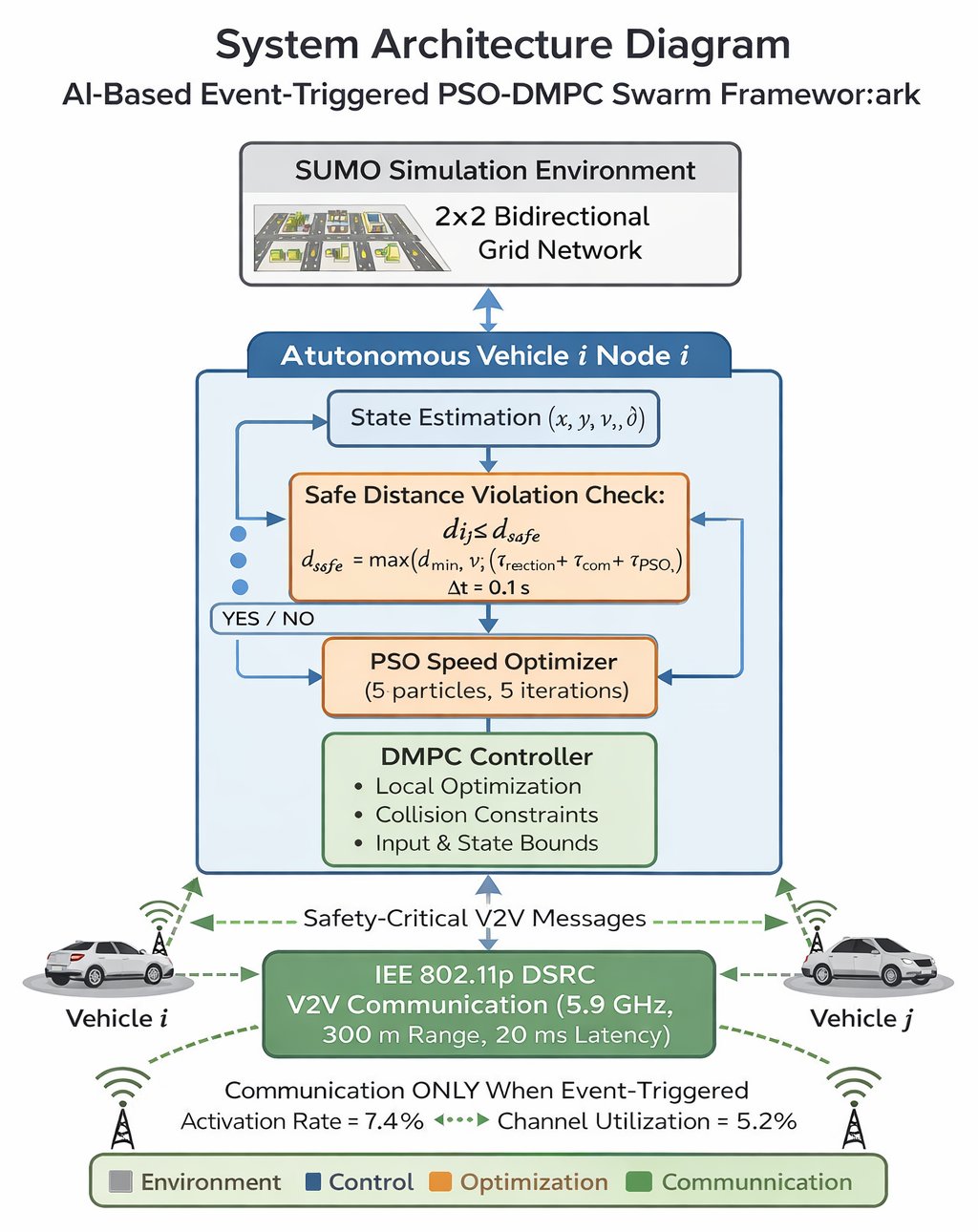
Event-Triggered PSO Speed Optimisation (Algorithm 1) — for each triggered agent:
- Initialise a swarm of Np = 5 particles, velocities drawn uniformly from [vmin, vmax]; best fitness ← ∞.
- For 5 iterations, evaluate the fitness function (Eq. 4 below) at each particle and track the personal/global best.
- Return the best candidate speed as the DMPC warm-start.
- Bounded by a 50 ms computation budget per trigger, making the routine embedded-hardware feasible.
The PSO subsystem only supplies a warm-start guess — it adds no additional hard constraints — so it cannot disturb the closed-loop stability properties already guaranteed by the DMPC layer.
05 Figures
06 Equations
07 Experimental Setup
Validated in SUMO (Simulation of Urban Mobility) over a 2×2 orthogonal grid network, 500 simulation steps at Δt = 0.1 s per run, across 20 independent random seeds — over 10,000+ simulation timesteps in total. Three configurations were compared: Baseline (SUMO car-following without AI), Continuous PSO (optimizes every step), and the proposed Event-Triggered PSO.
Default parameters: free-flow speed v ∈ [3, 18] m/s, minimum separation dmin = 10 m, N = 10 vehicles, Np = 5 particles, I = 5 PSO iterations, 5-step anti-chattering cooldown. V2V communication modeled over IEEE 802.11p DSRC (5.9 GHz, 300 m range, 20 ms latency).
08 Results
| Metric | Baseline | Continuous PSO | Event-Triggered PSO |
|---|---|---|---|
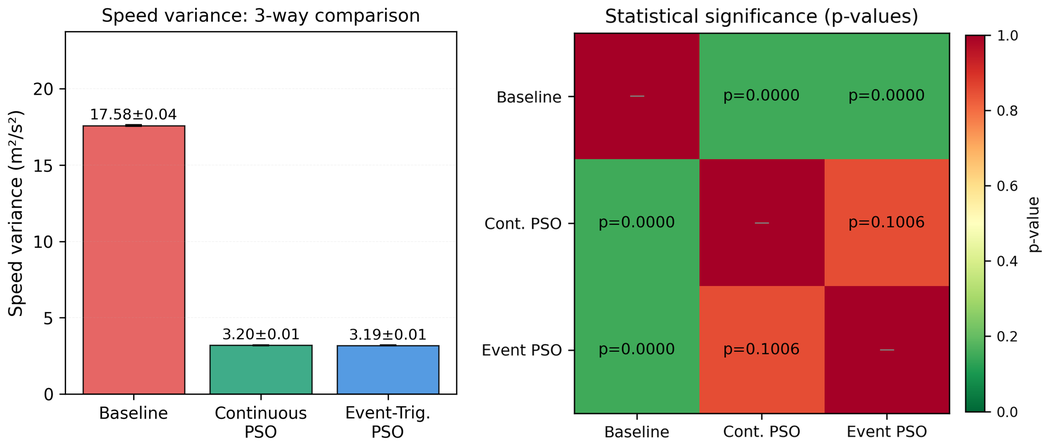
| Speed variance (m²/s²) | 17.58 ± 0.04 | 3.20 ± 0.01 | 3.19 ± 0.01 |
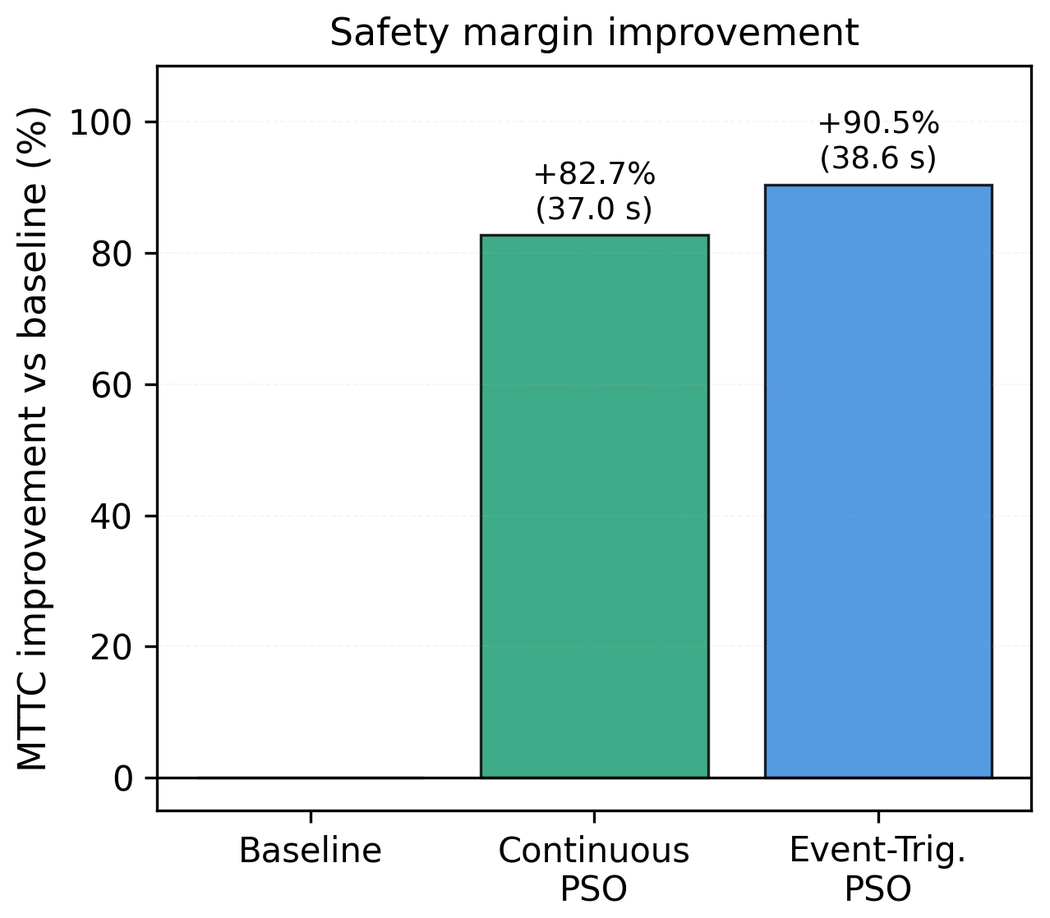
| MTTC (s) | 20.25 | 37.00 (+82.7%) | 38.57 (+90.5%) |
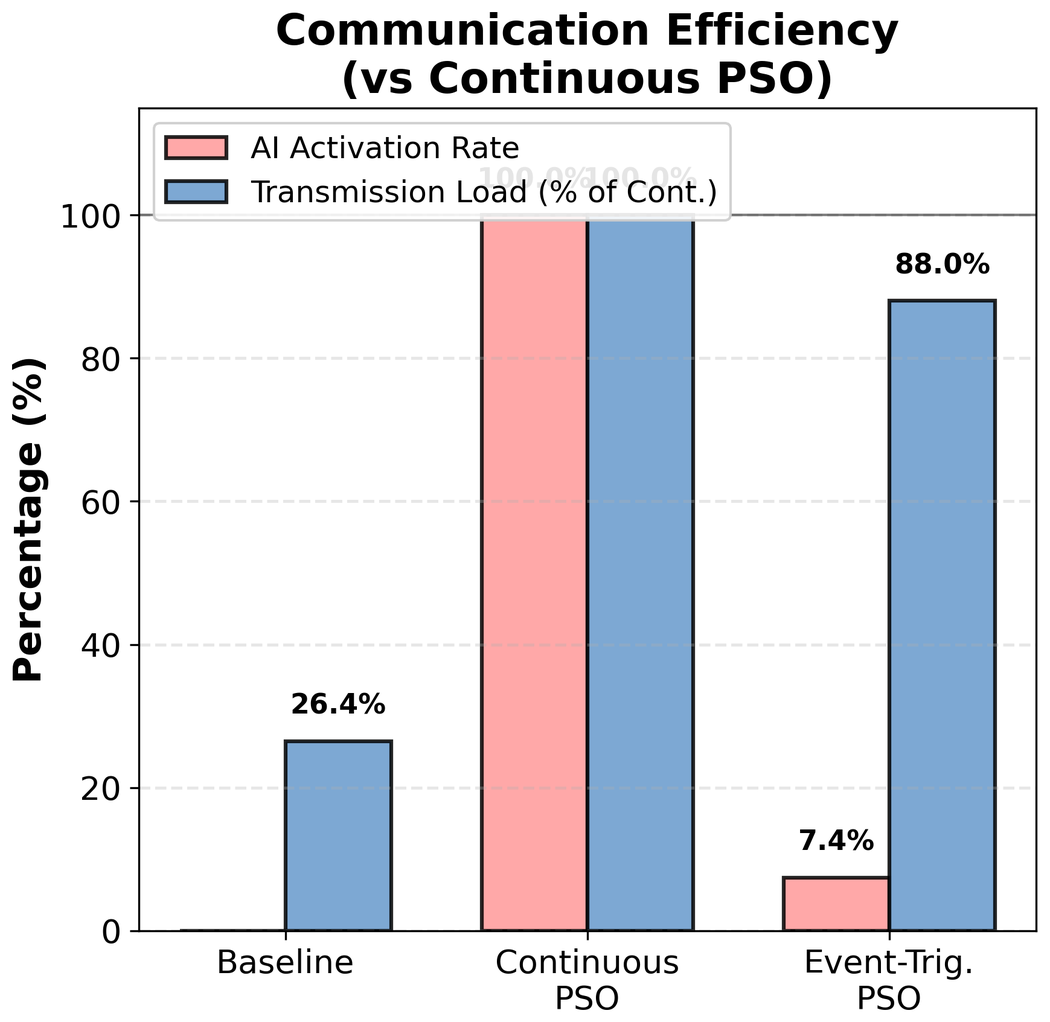
| CPU cost / step | 0.12 ms | 2.80 ms | 0.45 ms (−84%) |
| Near-miss events | 3083 | 2800 | 2748 (−10.9%) |
| Collisions (10,000+ timesteps) | — | — | 0 |
ET-PSO matches Continuous PSO's speed-variance and safety performance (p=0.101, not significant) at 84% lower per-step compute cost. All differences vs. Baseline are significant at p<0.001. Formation error (target 15 m spacing) drops 48.4% under ET-PSO (62.5 → 32.3 m) versus Baseline, though full string stability (disturbance amplification <1) was not achieved in every run.
Note from the manuscript: SUMO's default collision-handling protocol does not simulate physical impacts — it teleports or removes vehicles instead — so the reported zero-collision result reflects the absence of safety-constraint violations (dij < dmin), not literal impact absence.
09 Ablations & Sensitivity
PSO parameter sensitivity (6 configurations, 20 trials each, 120 trials total): speed variance ranges 2.31–2.64 m²/s² across inertia/cognitive/social-weight variants — all within one standard deviation of the default (2.40 ± 1.28) — with zero collisions in every configuration.
| Config | w | c₁ | c₂ | Variance (m²/s²) |
|---|---|---|---|---|
| Default | 0.7 | 2.0 | 2.0 | 2.40 ± 1.28 |
| Low inertia | 0.4 | 2.0 | 2.0 | 2.64 ± 1.24 |
| High inertia | 0.9 | 2.0 | 2.0 | 2.35 ± 1.38 |
| High social | 0.7 | 2.0 | 2.8 | 2.31 ± 1.21 |
Density robustness (5–26 vehicles, 20 trials each): speed variance grows sub-linearly with fleet size (1.59 → 10.70 m²/s²), with zero collisions at every density tested — evidence of graceful degradation rather than a hard failure point.
10 Failure Cases
At the highest tested density (26 vehicles), speed variance jumps to 10.70 m²/s² — noticeably higher than the 1.59–3.19 m²/s² range seen at lower densities, the roughest regime the framework was tested against. Full string stability (disturbance amplification factor < 1) was not obtained in every experimental run, even though overall group cohesion improved substantially over baseline. And because SUMO's collision handling teleports vehicles rather than modeling physical impact, the "zero collisions" result should be read as zero safety-constraint violations rather than a literal crash-test guarantee.
11 Limitations
- String stability was not achieved with speed-only control in every scenario.
- Formal Lyapunov/Control-Barrier-Function proofs are deferred to future work — the current safety argument is a practical, empirically-supported one rather than a closed formal proof.
- PSO weights (inertia, cognitive, social) are manually tuned, not learned.
- Cyber-attack and denial-of-service resilience of the triggered communication channel is not modelled.
- Validation is simulation-only (SUMO), with embedded-hardware feasibility (NVIDIA Jetson) argued from the 50 ms compute budget rather than demonstrated on physical hardware.
12 Future Work
- A density-adaptive safety threshold dsafe(ρ, v) that responds to local traffic density rather than a fixed margin.
- Formal Lyapunov/CBF stability proofs to close the gap left by the current practical-invariance argument.
- Hardware-in-the-loop validation on embedded platforms (e.g. NVIDIA Jetson) to confirm the simulated 50 ms compute budget holds on real hardware.
- Modelling denial-of-service and cyber-attack resilience for the event-triggered DSRC channel.